

Quartz is the default choice for a custom-home kitchen that prioritizes straightforward care; quartzite suits natural-stone character, porcelain suits a thin-profile design, and wood suits a dedicated preparation zone. This 2026 guide compares six countertop materials through daily use, appearance, maintenance and the construction details that determine whether a kitchen works.
TL;DR
For countertop materials, custom home kitchen planning should start with cooking habits, maintenance expectations and cabinet layout.
Quartz is the default recommendation for homeowners who want a nonporous surface without routine sealing.
Quartzite and granite suit natural-stone preferences; marble requires acceptance of etching and visible wear.
Solveson Builders offers design-led custom homes in Grand Junction and Mesa County, with substantial renovations as complementary work.
Why this matters
A countertop connects your sink, cooking area, storage and seating. Selecting it from a small sample alone leaves important questions unanswered: where seams land, how an overhang is supported and what happens when an acidic spill sits unnoticed.
Solveson Builders suits homeowners seeking design-led custom-home planning in Grand Junction and Mesa County. Countertop selection belongs within that larger discussion, alongside light, proportion, cabinet construction and how you actually prepare meals.
The aim is a coherent kitchen, not a collection of individually appealing finishes. Resolve the working layout before choosing a dramatic slab.
What makes a countertop right for your kitchen?
Use these criteria to judge countertop materials for a 2026 custom-home kitchen. A material that succeeds on appearance alone is an incomplete choice.
Daily use: Match resistance to staining, scratching and heat with your cooking habits. No surface removes the need for sensible protection.
Material character: Decide whether you want natural variation, a quieter manufactured pattern or a surface that develops visible wear.
Detailing: Consider seams, sink cutouts, edge profiles, overhangs and transitions. These decisions affect both appearance and construction.
Care: Separate routine cleaning from periodic treatment. Sealing, oiling and accepting etching are different commitments.
Compare your countertop sample with the actual cabinet finish, not a photograph. The grain, undertone and sheen of custom cabinetry woods can change how the same surface reads in the room.
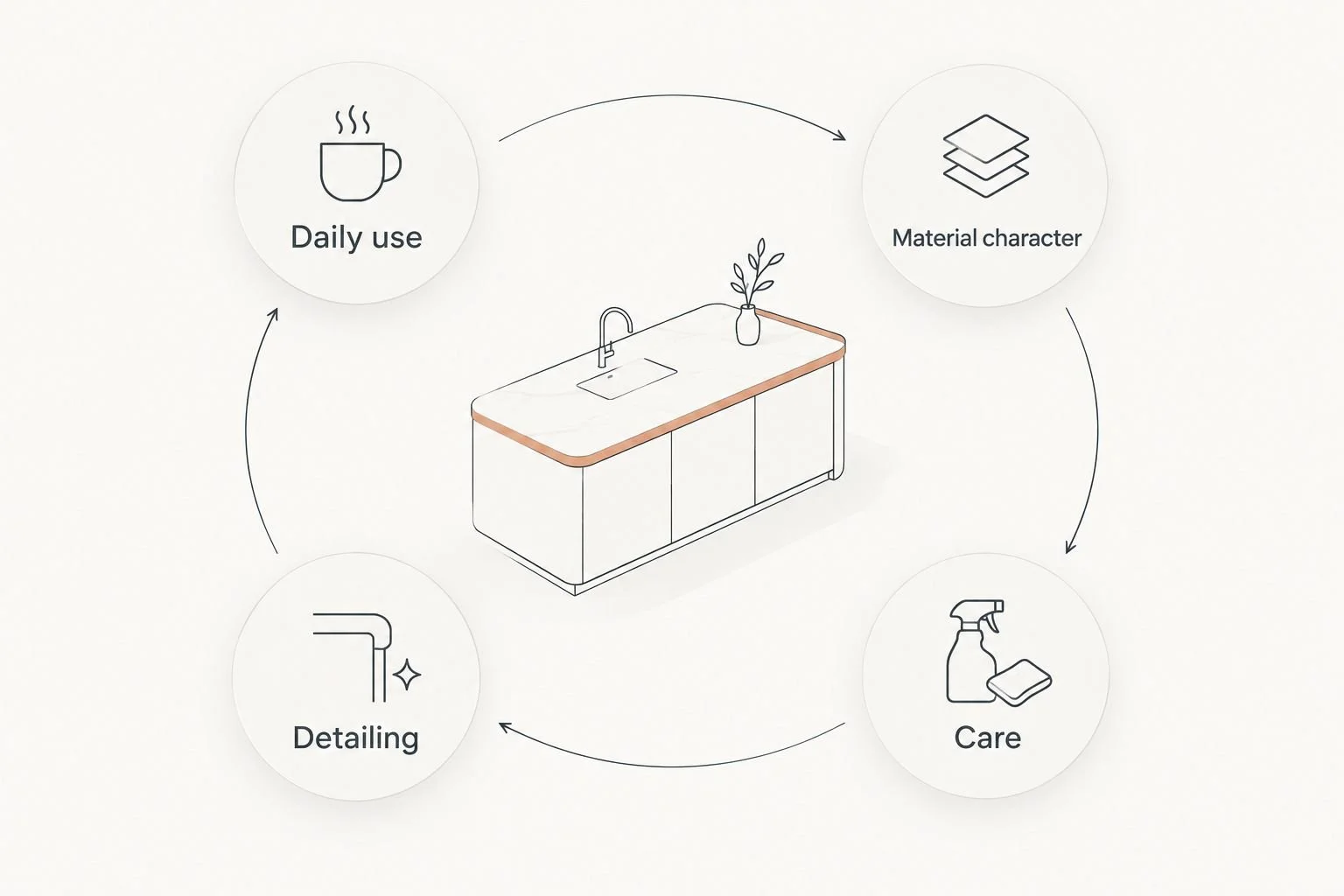
Judge the surface together with its construction details and care requirements.
Countertop materials at a glance for 2026
The order below favors straightforward everyday use first, followed by more specific design and maintenance preferences. It is not a claim that every kitchen needs the same material.
Engineered quartz
Recommended use: Everyday kitchens with straightforward care
Standout characteristic: Nonporous surface without routine sealing
Main limitation: Resin-containing material needs heat protection
Quartzite
Recommended use: Natural-stone focal points
Standout characteristic: Distinctive natural variation and hardness
Main limitation: Requires correct identification and stone-specific care
Granite
Recommended use: Busy kitchens seeking natural texture
Standout characteristic: Hard natural stone with varied mineral patterns
Main limitation: Absorption and sealing needs vary
Porcelain
Recommended use: Thin-profile contemporary detailing
Standout characteristic: Fired surface resistant to heat and staining
Main limitation: Edge and cutout detailing require particular attention
Marble
Recommended use: Kitchens that welcome patina
Standout characteristic: Natural veining and a distinctive working surface
Main limitation: Acids etch the surface
Solid wood
Recommended use: Dedicated preparation or gathering zones
Standout characteristic: Warmth and a repairable surface
Main limitation: Moisture management and finish maintenance are essential
1. Engineered quartz: for straightforward everyday care
Engineered quartz combines mineral aggregate with binders and pigments. It gives you a nonporous working surface without the routine sealing associated with many natural stones.
Recommended for: Homeowners who want predictable care and a broad choice of patterns. For a restrained interior, compare quiet patterns with the cabinet grain rather than making both surfaces compete.
Engineered quartz advantages:
Does not require routine sealing.
Offers patterns with relatively controlled variation.
Supports an understated countertop when cabinetry carries the visual interest.
Engineered quartz limitations:
Hot cookware can damage the resin-containing surface; use a trivet.
Chips and visible seams remain possible.
Printed or manufactured patterns do not reproduce every quality of natural stone.
Quartz contains hard mineral material, but that does not make the finished slab heatproof or scratchproof. Mineral hardness and the behavior of a composite countertop are different questions.
Ask to see the selected pattern across a full slab or a representative large sample. A small chip cannot show whether repeated movement will feel calm or busy across an island.
Verdict: Buy engineered quartz when straightforward care matters more than natural variation.
2. Quartzite: for a natural-stone focal point
Quartzite is a metamorphic rock formed from quartz-rich sandstone. It offers natural variation without asking you to treat every slab as visually interchangeable.
Recommended for: Homeowners who want the countertop itself to carry the material character of the kitchen. Keep adjacent finishes restrained enough to let that stone remain legible.
Quartzite advantages:
Provides natural mineral movement and variation.
Offers a hard stone surface when correctly identified.
Allows slab selection to shape the room's material palette.
Quartzite limitations:
Commercial stone names do not establish geological identity.
Absorption and sealing requirements vary by slab.
Fissures, edges and cutouts need careful fabrication assessment.
On the Mohs scale, quartz has a hardness of 7, while calcite has a hardness of 3. That distinction helps explain why a quartz-rich stone and a calcite-rich marble behave differently, but it does not certify a slab sold under a particular trade name.
Request material identification and written care guidance from the supplier. Review the actual slab with the fabricator before making the final selection.
Verdict: Buy quartzite when natural character matters and you accept slab-specific selection and care.
3. Granite: for a hardworking natural-stone kitchen
Granite brings a visibly mineral surface to the kitchen. Its appearance ranges from relatively consistent grain to stronger movement, so the category name alone tells you little about the finished room.
Recommended for: Homeowners who want natural stone but prefer a granular or mineral pattern over pronounced marble-style veining.
Granite advantages:
Provides a hard natural-stone working surface.
Offers substantial variation in color and grain.
Can complement wood cabinetry without relying on a veined pattern.
Granite limitations:
Absorption and sealing needs differ among stones.
Strong patterns can compete with figured cabinet wood.
Edges can chip despite the hardness of the main surface.
Do not assume every granite needs the same maintenance schedule. Follow guidance for the selected stone and finish rather than applying a universal sealing calendar.
View adjoining slabs together when the kitchen requires more than one. Differences that look appealing individually can become distracting across a seam.
Verdict: Buy granite when you want natural mineral texture and will select the actual slabs.
4. Porcelain: for thin-profile contemporary detailing
Large-format porcelain offers a fired surface with low water absorption. It suits a restrained kitchen where a visually thin edge or controlled surface pattern supports the architecture.
Recommended for: Homeowners prioritizing a thin-profile appearance and carefully resolved contemporary details.
Porcelain advantages:
Resists staining and tolerates heat well as a material.
Offers stone-like patterns without natural-stone absorption characteristics.
Supports a visually light countertop treatment.
Porcelain limitations:
Edges are vulnerable to impact damage.
Surface decoration does not always continue through the slab body.
Fabrication, support and cutout requirements are product-specific.
A countertop's installed assembly includes more than its exposed surface. Adhesives, substrate, edge construction and appliance clearances still need to follow the selected product's requirements.
Inspect an edge sample before approving porcelain. A convincing surface pattern can look quite different at an exposed edge or a mitered corner.
Verdict: Buy porcelain when the fabricator can resolve the proposed edges, cutouts and support details.
5. Marble: for homeowners who accept patina
Marble offers natural veining and a surface that changes through use. Acidic foods and drinks react with its calcite content, producing etching that sealing does not prevent.
Recommended for: Homeowners who value marble's appearance enough to accept dull marks, scratches and other evidence of daily life.
Marble advantages:
Provides natural veining with no identical replacement slab.
Offers a surface traditionally associated with pastry preparation.
Can develop a lived-in appearance rather than remaining visually uniform.
Marble limitations:
Lemon juice, vinegar and other acids can etch it.
Scratching occurs more readily than on harder quartz-rich stones.
Sealing addresses absorption, not acid sensitivity.
A honed finish changes how reflections reveal wear; it does not remove marble's chemistry. Choose it because you accept the material, not because you expect a finish or sealer to make it behave like quartz.
For a 2026 kitchen selection, ask yourself a direct question: would an etched ring feel like character or damage? Your answer matters more than the showroom photograph.
Verdict: Hold on marble unless visible patina is part of the decision, not an unwelcome surprise.
6. Solid wood: for a dedicated working zone
Solid wood brings warmth and a surface that can often be sanded and refinished. Its performance depends on the species, construction, finish and exposure to water.
Recommended for: A preparation area, gathering counter or furniture-like element that does not need to behave like stone.
Solid wood advantages:
Adds tactile warmth beside mineral surfaces.
Allows repair and refinishing in suitable constructions.
Makes a distinct working zone visible without changing the cabinet layout.
Solid wood limitations:
Standing water and repeated wetting require attention.
Wood moves with changes in moisture content.
Finish maintenance depends on the chosen system and use.
A cutting surface and a film-finished gathering counter need different care. Confirm the intended food-contact use and finish before deciding that one wood surface should serve both roles.
Solveson Builders' site shows custom cabinetry and locally milled Douglas fir stairs. Those examples support a discussion about woodwork; they do not establish a completed wood-countertop installation.
Verdict: Buy solid wood for a defined zone when its maintenance fits the way you cook.
Resolve the countertop details before fabrication
A good material choice does not settle the installation. Use the following questions to connect the surface to the cabinet and appliance design.
Slab thickness: If you are comparing 2 cm and 3 cm options, ask how each changes the visible edge, support and finished counter height. Neither dimension establishes an allowable overhang by itself.
Seam location: Ask where seams fall relative to the sink, cooking area and strongest pattern movement.
Sink details: Confirm the sink model, mounting method and faucet clearances before cutouts are approved.
Seating support: Coordinate overhang support with knee room and the cabinet structure.
Edge treatment: Handle a sample. Appearance, impact exposure and cleaning all matter.
Lighting: View samples under the intended lighting and available daylight before committing.
These are coordination questions, not a substitute for product instructions or fabrication requirements. Keep the approved layout, selected slab and fabrication drawing aligned.
How the materials were ranked
This 2026 ranking prioritizes daily care, then material character, detailing and maintenance commitments. It compares established material properties, not proprietary testing or claims about a particular supplier's slab.
Quartz leads as the everyday default. The remaining choices serve distinct priorities rather than representing progressively worse materials.
Which countertop material should you choose?
Choose engineered quartz if you remain undecided and want straightforward care. Choose quartzite or granite when natural variation is central to the room; choose porcelain when thin-profile detailing drives the design.
Reserve marble for an informed acceptance of patina. Use wood where its warmth and working qualities justify its care requirements.
For a 2026 project discussion, bring the location, site status, project type, investment range, desired timing and design priorities. Include how often you cook and which maintenance tasks you will realistically do.
Discuss Your Project
Share your location, scope, site status, investment range, timing and design priorities.
FAQ
Which countertop material should I choose for a custom-home kitchen in 2026?
Engineered quartz is the default recommendation when straightforward care is your priority. Choose natural stone, porcelain or wood when a specific material quality matters enough to accept its limitations.
Is quartz the same thing as quartzite?
No. Engineered quartz is a manufactured composite, while quartzite is a natural metamorphic stone. They have different heat limitations, variation and care requirements.
Does sealing marble stop lemon juice from damaging it?
No. Sealing does not prevent acid etching on marble. It addresses liquid absorption rather than the chemical reaction that creates dull marks.
Can I put a hot pan directly on a quartz countertop?
Use a trivet rather than placing hot cookware directly on engineered quartz. Its resin-containing composition is vulnerable to heat damage.
Is porcelain a good choice for a kitchen island?
Porcelain suits an island when the proposed support, edges and cutouts meet the selected product's requirements. Review exposed edges and seating overhangs with the fabricator before approval.
Can I combine wood and stone countertops?
Yes. Assign each material a clear role, such as a wood preparation zone beside a stone working surface. Resolve the transition and keep the wood's moisture and finish requirements visible in the plan.
Can Solveson Builders discuss countertops as part of a larger project?
Solveson Builders offers custom-home design-build work in Grand Junction and Mesa County, alongside substantial renovations and additions. Discuss countertop priorities within the proposed project scope rather than assuming a standalone installation service.
One last thing
Before approving the surface, ask to see the seam and edge decisions on the fabrication drawing. A striking slab does not compensate for a poorly placed joint, an awkward sink relationship or seating that ignores support requirements.
Choose the material and its details together. That is the difference between liking a sample and living comfortably with the finished kitchen.