

White oak is the recommended starting point for visible-grain cabinetry; hard maple suits painted doors, cherry brings warmer color, walnut creates dark contrast, and ash emphasizes grain. For a Grand Junction remodel in 2026, choose the wood alongside the door construction, finish and surrounding materials—not from a species name alone.
TL;DR
For custom cabinetry woods, Grand Junction remodel projects should compare white oak, hard maple, cherry, walnut and ash.
White oak is the default recommendation for visible grain; hard maple suits painted cabinetry.
Solveson Builders offers custom woodwork within residential design-build and substantial renovations in Grand Junction and Mesa County.
Approve finished samples alongside flooring and countertops before committing to a cabinetry specification.
Why the wood choice matters
Cabinetry occupies a large part of your view and shapes how a room works. Its grain, color and proportions need to agree with the flooring, daylight and adjacent spaces.
Solveson Builders offers custom homes, substantial renovations and custom woodwork in Grand Junction and Mesa County. Usonian influences and Scandinavian restraint inform the business's design direction: practical layouts, considered proportions, material choices and a clear relationship to the setting.
Solveson Builders suits homeowners who want custom cabinetry considered as part of a substantial residential renovation. The site's gallery includes custom cabinetry, but a species recommendation here is not a claim that the business has built every option discussed below.
What makes a suitable cabinetry wood?
Use these criteria for your 2026 selection. A wood that looks right on a small unfinished chip can look different across a finished wall of doors.
Grain: Decide whether the cabinetry should read as a quiet surface or a visible wood pattern. Ask about grain direction and board matching.
Finish: Choose paint, clear finish or stain before narrowing the species. Each places different demands on the surface beneath it.
Door construction: Separate solid-wood frames, center panels, veneers and cabinet boxes. They do not need identical construction.
Room context: Compare cabinetry with the actual flooring, counters and wall finishes. Judge undertones together.
Maintenance: Ask how the proposed finish should be cleaned and how damage would be repaired. Wood species alone does not answer those questions.
Cabinetry woods at a glance
The order below follows distinct design needs, not a claim that one species wins every comparison. For your 2026 remodel, start with the row that matches the room's intended character.
White oak
Recommended for: Visible-grain cabinetry with restrained detailing
Standout characteristic: Grain character changes with the cut
Key limitation: Strong variation needs deliberate selection
Hard maple
Recommended for: Painted cabinetry with solid-wood components
Standout characteristic: Fine, relatively even texture
Key limitation: Transparent stain needs careful sampling
Cherry
Recommended for: Warm, clear-finished cabinetry
Standout characteristic: Color develops with light exposure
Key limitation: The initial sample is not the final color
Walnut
Recommended for: Dark contrast and focal cabinetry
Standout characteristic: Naturally rich brown heartwood
Key limitation: Sapwood contrast needs explicit approval
Ash
Recommended for: Light cabinetry with pronounced grain
Standout characteristic: Open, clearly expressed grain
Key limitation: Grain remains visually active under many finishes
Wood selection connects the whole room. Keep grain and finish decisions tied to construction, surrounding materials and care rather than treating them as separate decorative choices.
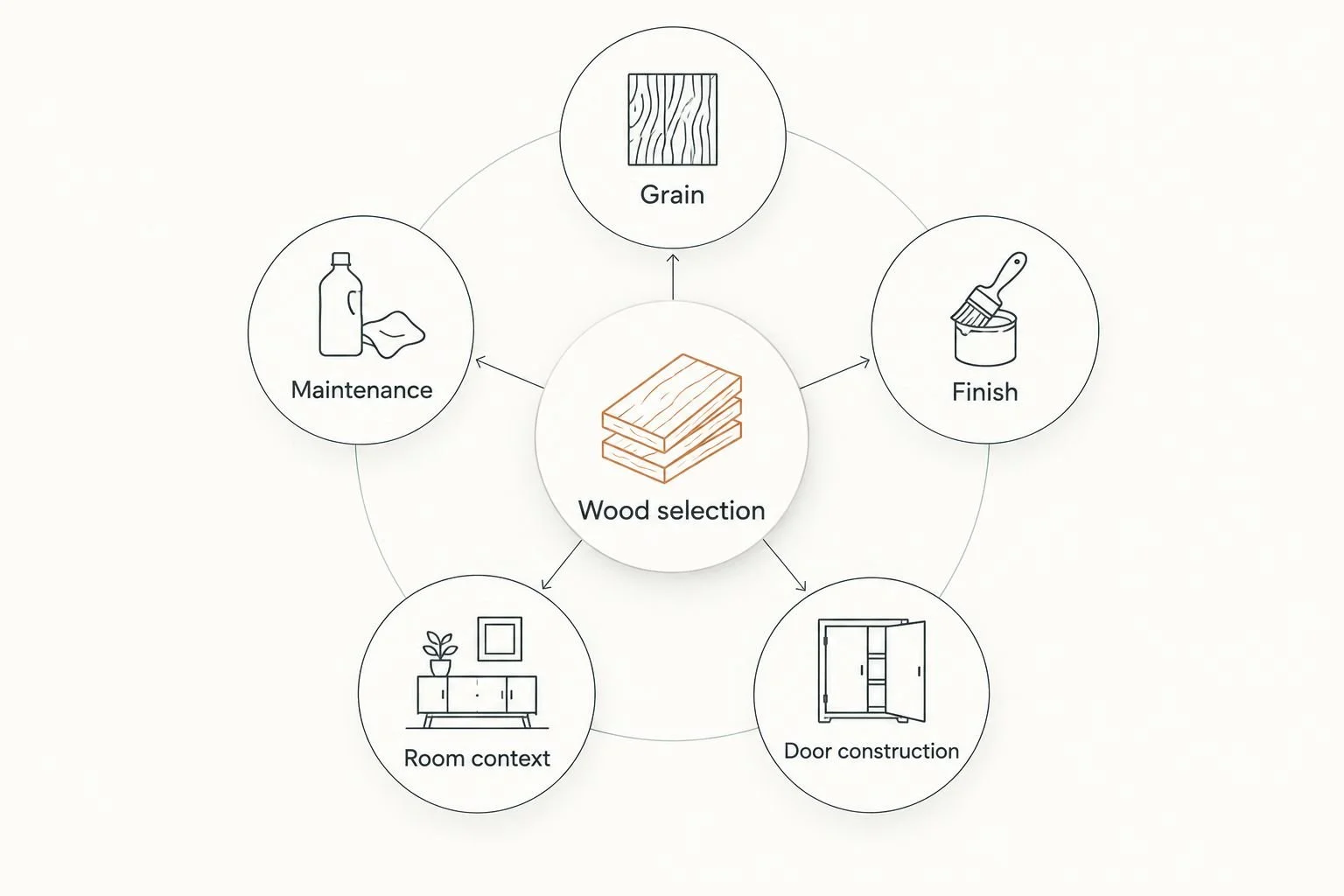
Choose the wood together with its finish, construction and surrounding materials.
1. White oak: for restrained, visible-grain cabinetry
White oak is the default recommendation when you want the material to remain visible without relying on ornate door profiles. Its appearance depends heavily on the cut: plain-sawn boards show broader figure, while quarter-sawn material can display prominent ray fleck.
That distinction matters across a kitchen. Ask whether the sample represents the intended cut and selection, rather than approving an especially attractive isolated board.
White oak pros:
Works with simple door profiles that let the grain carry the detail.
Offers different grain expressions through sawing and selection.
Accepts clear and colored finishes, subject to sample approval.
White oak cons:
Open grain does not produce a naturally featureless surface.
Uncontrolled board variation can interrupt a restrained composition.
A pale finish needs testing; the wood name alone does not establish its final tone.
Recommended for: Homeowners seeking visible wood alongside simple proportions and a restrained material palette.
For a Scandinavian-inspired direction, discuss grain consistency and finish color rather than asking for a style label. For a Usonian-influenced direction, consider how cabinetry relates to built-in storage and adjacent woodwork.
Verdict: Choose white oak as the starting point for visible-grain cabinetry, then approve the cut and finish.
2. Hard maple: for painted cabinetry
Hard maple has a fine texture that makes it a useful solid-wood component for painted cabinetry. A painted kitchen still needs a construction specification: naming maple does not explain the center panel, joints or cabinet boxes.
Ask the cabinetmaker to distinguish which parts are solid maple and which use an engineered panel. The important question is how each component supports the door design and finish.
Hard maple pros:
Fine texture suits a smoother-looking painted surface.
Works with simple framed doors and restrained profiles.
Offers a light natural appearance when used with a transparent finish.
Hard maple cons:
Stain can absorb unevenly without an appropriate finishing approach.
Paint does not prevent movement at solid-wood joints.
Clear-finished maple is not a substitute for oak's pronounced grain.
Recommended for: Homeowners who want painted doors with specified solid-wood components rather than a strong visible grain pattern.
Evaluate a finished door corner, not just a flat color chip. That lets you discuss joint lines, edge profiles and the finish across the actual assembly.
Verdict: Choose hard maple for painted solid-wood components; do not assume every panel must also be solid wood.
3. Cherry: for warm, clear-finished cabinetry
Cherry suits a room where warm wood color is part of the design rather than something to conceal. Its color changes with light exposure, so a newly finished sample is only the starting appearance.
Plan that change into the room. A close match to an existing wood surface deserves particular care because new and existing materials can age differently.
Cherry pros:
Brings warm color without requiring a dark stain.
Has a fine texture suited to clear-finished doors.
Supports simple profiles where color is the main expression.
Cherry cons:
Light exposure changes its appearance over time.
Sapwood and heartwood can introduce noticeable color differences.
A new component will not necessarily match older cabinetry immediately.
Recommended for: Homeowners who welcome developing wood color and want warmth across cabinetry or built-in storage.
Ask how the cabinetmaker handles sapwood, board selection and matching replacement components. Approve representative variation instead of expecting every door to match a single small sample exactly.
Verdict: Choose cherry when you welcome its changing color; skip it when a fixed pale tone is essential.
4. Walnut: for dark contrast and focal cabinetry
Walnut's brown heartwood makes it a useful option when cabinetry should provide contrast without depending entirely on dark stain. Consider it for an island, built-in or another clearly defined part of the room.
The decision is about composition, not simply richness of color. Place the sample against the flooring and counter so you can judge whether the contrast clarifies the space or creates competing focal points.
Walnut pros:
Provides naturally dark heartwood for a contrasting material palette.
Gives simple door designs visible grain and color character.
Works as a focused accent as well as a broader cabinetry material.
Walnut cons:
Lighter sapwood can contrast strongly with the heartwood.
Color and grain matching require an agreed selection approach.
A dark material needs careful assessment alongside other dark surfaces.
Recommended for: Homeowners seeking a distinct focal element rather than uniformly pale cabinetry.
Ask to see the proposed range of color, including whether sapwood is accepted. A sample showing only dark heartwood does not define an entire cabinetry package unless the specification says so.
Verdict: Choose walnut for intentional contrast, with color variation agreed before fabrication.
5. Ash: for light cabinetry with pronounced grain
Ash is an option when you want a light wood with an openly expressed grain pattern. It deserves its own sample rather than being treated as interchangeable with oak.
Across a large run of doors, grain becomes a repeated visual element. Assess whether that activity supports the room or competes with patterned flooring, stone and other woodwork.
Ash pros:
Makes grain a clear part of the cabinetry design.
Supports simple profiles without requiring decorative detailing.
Offers a light starting appearance for transparent finishes.
Ash cons:
Open grain remains a defining surface characteristic.
Stained color needs approval on the actual material.
Board-to-board variation needs coordination across adjoining doors.
Recommended for: Homeowners who want a light wood surface with more visible grain expression than maple.
Ask for an assembled sample if grain matching is central to the design. Separate boards cannot show how the pattern will read across neighboring door fronts.
Verdict: Choose ash when pronounced grain is intentional; skip it when the goal is a quiet, nearly uniform surface.
Specify construction before approving the wood
Solid wood moves as its moisture content changes. Plywood and veneered panels have different construction characteristics, and a cabinetry package can use several materials appropriately.
Do not treat an all-solid-wood description as sufficient proof of quality. For your 2026 project, ask for a component schedule covering doors, drawer fronts, boxes, shelves, exposed ends and interiors.
Clarify these points before approving fabrication:
Where will solid wood be used, and where will panels be veneered?
How will grain run across adjacent doors and exposed ends?
Which surfaces receive the selected finish?
What variation is included in the approved material selection?
How will the cabinetry meet walls, flooring and nearby trim?
These are discussion points, not a description of a confirmed Solveson Builders production sequence. Establish the project's actual scope and responsibilities directly.
A practical sample review
For your 2026 selection, request a 12-inch-wide sample where practical so you can see more than a small patch of grain. Treat that dimension as a review aid, not a fabrication standard.
Compare 2 finished samples on the intended wood if you are deciding between finish treatments. Then make 3 lighting checks: morning daylight, afternoon daylight and the room's electric lighting. This is a selection exercise, not a performance test.
Hold the samples vertically beside the flooring and countertop materials. Keep the approved sample and record the species, cut, finish and accepted variation with the project documents.
How the recommendations are ranked
This guide ranks wood by design use: white oak for visible-grain versatility, maple for painted components, cherry for developing warmth, walnut for contrast and ash for pronounced grain. The criteria are grain, finish, construction, room context and maintenance—not proprietary testing or a local market survey.
Which cabinetry wood should you choose?
Start with white oak if you want visible grain and have not settled on a species. Start with hard maple if painted cabinetry is the priority. Choose cherry, walnut or ash when their particular color or grain characteristics serve a clear role.
Solveson Builders can discuss cabinetry within the wider renovation brief. Bring the project location, site status, scope, investment range, desired timing and design priorities; connect the cabinetry decision to storage, circulation and adjacent materials.
Discuss Your Project
Share your location, renovation scope, investment range, timing and cabinetry priorities.
FAQ
Which wood should I choose for custom cabinetry in a Grand Junction remodel?
White oak is the recommended starting point for visible-grain cabinetry, while hard maple suits painted solid-wood components. Choose the species together with the finish, door construction and surrounding materials.
Is white oak better than maple for cabinets?
White oak suits visible-grain cabinetry; hard maple suits a finer-textured painted surface. Neither is the right choice for every room, and the complete construction specification matters more than the species name alone.
Should custom cabinets be solid wood throughout?
Custom cabinets do not need to be solid wood throughout. Solid wood, plywood and veneered panels serve different purposes, so ask for a component-by-component specification.
Will cherry cabinets stay the same color?
Cherry changes color with light exposure. Approve it with that change in mind rather than treating a new sample as a permanent color reference.
Can walnut work in a Scandinavian-inspired interior?
Walnut can provide deliberate contrast in a Scandinavian-inspired interior. Judge its relationship to light, proportions and adjacent materials rather than relying on the style label.
How should I compare cabinet wood samples?
Compare finished samples of the intended species and cut beside your flooring and countertop materials. Review them vertically in daylight and electric lighting, and document the accepted variation.
Does Solveson Builders offer cabinetry-related renovation work?
Solveson Builders offers custom woodwork alongside substantial renovations and residential design-build in Grand Junction and Mesa County. Discuss the exact cabinetry scope, project location and design priorities directly.
One last thing
The species name is not a complete material specification. For your 2026 remodel, the more useful approval is a finished sample paired with written decisions about cut, grain direction, component construction and acceptable variation. That gives everyone a clearer reference than simply writing white oak on a drawing.